Which Healthcare Course Is Right for You? 3 Questions That Actually Help
Petra Allied Health offers nine different courses, and they cover a wide range of work: hands-on patient care, technical and diagnostic roles, behind-the-scenes office work, and even animal care. The right starting point depends on who you are and what you’re looking for.
These three questions can help you narrow it down.
1. What do you want your day to look like?
The courses we offer lead to very different types of jobs. It’s worth thinking about what you’d enjoy doing on a daily basis before you pick one.
If you want to be in the room with patients, physically helping with their care and comfort, courses like CNA (90 hours), Medical Assistant (184 hours), and Dental Assistant (240 hours) are designed for that. CNA work in particular centers on close, physical care. It’s demanding, and it’s one of the most personally rewarding roles in healthcare for people who connect with it.
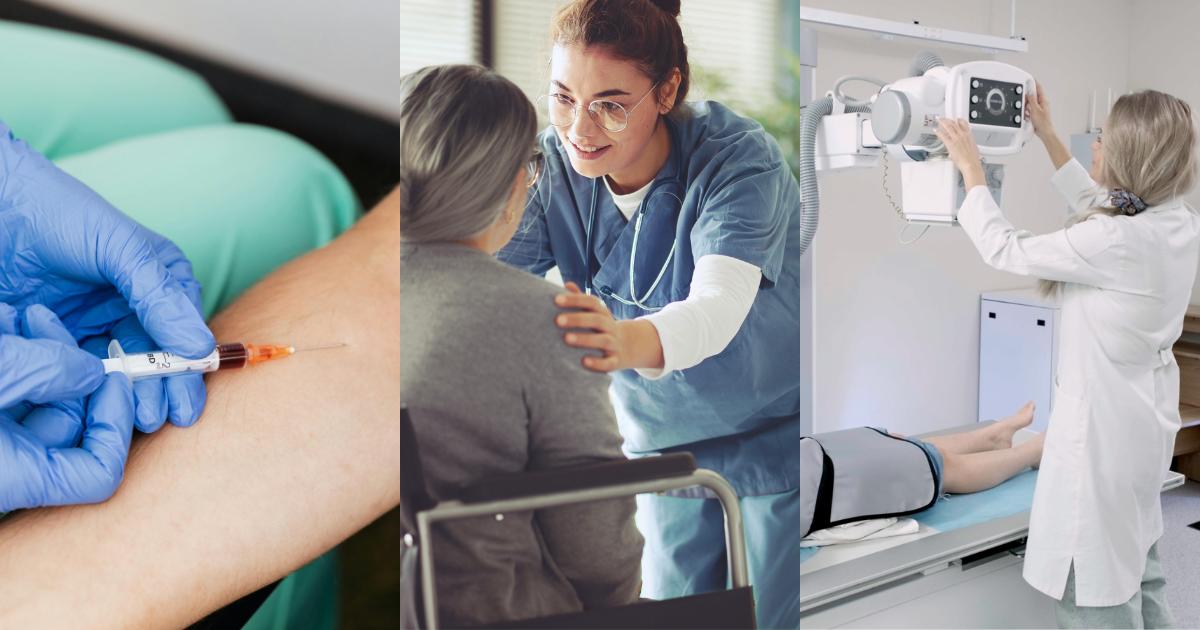
If you prefer focused, technical work where you’re performing a specific clinical procedure, take a look at Phlebotomy (64 hours), EKG (48 hours), or LLRT (84 hours). You’re still in a clinical environment, but the work is more specialized. Phlebotomy technicians collect and prepare blood samples. EKG technicians run heart rhythm tests. LLRTs perform limited-scope diagnostic X-rays under physician supervision.
If you’re more interested in working with records, data, and insurance systems, Medical Billing and Coding (120 hours) is worth a close look. The work involves ICD-10 codes, claims processing, and medical documentation. Hospitals, clinics, and insurance companies all hire for these roles, and most of the day is spent at a desk rather than on a clinical floor.
And if you’d rather work with animals, the Veterinary Assistant course (64 hours) is the only one in our lineup built for that.
2. How much patient contact do you want?
This is worth thinking about separately from what kind of work interests you. Someone might be drawn to a clinical role but find that constant patient interaction isn’t what they expected. Or they might assume a desk job means zero human contact when it doesn’t have to.
The courses range from constant, hands-on patient interaction (CNA, Medical Assistant, Dental Assistant, Veterinary Assistant) to procedure-based contact where you see patients briefly for specific tasks (Phlebotomy, EKG, LLRT) to minimal or no direct patient contact at all (Medical Billing and Coding, Pharmacy Technician at 48 hours). It’s a better question to ask yourself now than to figure out on the job.
3. How soon do you want to be working?
Our shortest courses, EKG and Pharmacy Technician, are each 48 hours and can be completed in a matter of weeks. CNA is 90 hours. Phlebotomy and Veterinary Assistant are 64 hours each. LLRT is 84 hours.
For a broader credential that takes more time, Medical Billing and Coding runs 120 hours, Medical Assistant is 184 hours, and Dental Assistant is 240 hours.
Nothing we offer takes years. The longest course is 240 hours. But there’s a real difference between finishing in a few weeks and finishing in a few months, especially if you’re balancing work or family while you train.
Still weighing your options?
If you’ve read through this and you’re not sure yet, the quiz below can help. It asks three quick questions and gives you a personalized recommendation with direct links to each course page.
Which course is right for you?
A few quick questions to point you in the right direction.
Questions? Call (800) 785-9876 · Mon–Fri 8AM–5PM
Or if you’d rather just talk it through, call us at (800) 785-9876, Monday through Friday, 8 AM–5 PM. No pressure — just a real conversation.